Wednesday, 8 February 2017

The possibilities of using slope to benefit the allotment.


My allotment slopes to the south east.  What advantages does that give to the allotment crops?  The aspect of the allotment can give quite an advantage.  Being south facing means that the sun's heat and light is a little more concentrated and will warm up the soil earlier in the year and allow crops to be grown later in the autumn. 

Path alongside the allotments looking down the south facing slope.


Although I grow crops in north south rows,  I have put in paths from east to west at right angles to the slope.  The paths have been made as mini ditches and soil has been taken out and put onto the growing areas to raise them.  The mini ditches are aligned more or less with the contours across the allotment.  Water will flow at right angles to the contours soaking in as it does.  Some surface water will flow into the ditches and spread out.   I have filled the  ditches  with woody shreddings which will soak up some of the water and prevent it from evaporating creating a reservoir of stored water. 

Espaliers planted on the top of the raised bank.


This allows surface rain water to be spread out evenly along the path, slowed down and soaked into the soil.  Although irrigation is not a particular priority in the UK climate, we still have to consider the effects of leaching and soil erosion. 


Raising the level of the soil, creating banks on the downside of the slope and planting espaliered fruit trees or soft fruit along the east west raised soil aids in the slowing down of water (mass flow) through the soil.  As the water is slowed, it allows dissolved nutrients to be taken up by plants before it is lost though leaching. 


As plant nutrients are soluble minerals they will be leached slowly as the water flows to the bottom of the slope.  I have planted comfrey at the bottom of the slope to catch as much leached nutrient as I can.  Their deep roots will absorb much of the available nitrogen and any potassium and phosphorus that is available.  The leaves and stems of the comfrey can then be composted, made into comfrey liquid or put into the worm bin to recycle the nutrients. 
It is all about slowing the mass flow of water through the soil.  This will slow leaching, allow more time for uptake of soluble minerals; capture eroded soil particles, enhance water filtration  and provide more opportunity for upward water capillary action for plant growth.


My compost heaps are at the top of the slope so that any leachate that they produce will flow down the slope and into the allotment soil.  In a similar way, I have planted perennial nitrogen fixing legumes along the top of the slope so that any nitrogen they fix will flow naturally into the allotment top soil.  I will be planting perennial legumes alongside the fruit trees and bushes on the banks alongside the paths so that nitrogen will flow with the water into the growing areas. 

Compost bins at the top of the slope so that leachate will flow into the allotment.


Laburnum and lupins planted at the top of the slope so that nitrogen they fix will
flow into the allotment growing areas.

In the UK there is often too much water flowing through the allotment.  It is necessary to put in some kind of drainage to prevent waterlogging.  I have dug out a trench at the bottom of the allotment and filled it with stone sieved from the top soil.  The stone was covered with paving slabs to make a path alongside the hedge. 
Drainage ditch under the slabs.  Path is at the bottom of the slope.   


During the driest months in summer, the soil is covered by mulches to reduce evaporation and the trench Hugelkultur further slows the soil water and retains it as a reservoir that is accessible to plant crop roots. 

So slopes can be very useful. 

Wednesday, 18 January 2017

Is mulch made from conifer wood chip or bark acidic?

I have seen it often suggested that organic mulches such as wood chip and bark from conifers are acidic.  The pH is a measure of the amount (the negative log of the concentration)of hydrogen ions and this measurement must be done in a liquid.  You cannot measure the pH of a solid unless you dissolve it in water.  As most of the solid from wood chip and bark  is insoluble in water, it is virtually impossible to measure the pH of these materials.


The woody chippings or bark could be giving off substances that acidify the soil solution as they decompose.  However, neither pine bark nor pine chippings have been found to have any effect on soil pH.  (Tahboub, Lendemann and Murray 2008) There is no significant change in soil pH for wood chip incorporated into soil measured over a three year period.   Bare soil is more likely to have a low pH (be acidic) than organic mulches.  Shredded bark and woodchip have been found to be the least acidifying of the organic mulches.

Regardless, wood chip could be shaken up in water and the resultant solution tested.  This should be done with distilled water or deionised water to make sure that you are testing the pH of the dissolved substance not the pH of the water.  Tap water contains a lot of substances although it usually has a neutral pH of around 7. 

Now, I haven't tested the pH of  woodchip solution, however I would conjecture that it would be fairly neutral or possibly slightly alkaline.  There are some that suggest that the phenolic substances secreted by the above ground structures of a plant may be acidic. I don't know. 

What I am going to do is test the soil beneath an estimated 2000 year old yew tree.  The tree is in my local nature reserve.  There is nothing growing under the tree within about a 50 food diameter. 

I would suggest that the pH of the soil is no different from the rest of the wood so I will take samples from outside the yew trees influence as well as under its canopy.  After 2000 years of falling litter surely it would have affected the soil underneath it. 

My suggestion is that there will be no difference between the soil pH from beneath the canopy of the yew tree and the soil from outside the canopy.   

The fact that there is no build up of litter under the tree would suggest to me that some invertebrates, such as worms, are feeding on the organic matter from the tree.  Worm's preferred habitat is one with a neutral or alkaline pH.

Usually scientific consensus is pretty solid, however sometimes explanations that purport to be scientific are merely based on hearsay and anecdote and need to be challenged by experiment. 

Sunday, 15 January 2017

Too much mulch?

It is self evident that if you cover a plant completely with mulch you will kill it through lack of light.  This is one of the benefits of mulching - weed control.  However, what is the correct amount of mulch to apply to crop plants? 

There is a lot of advice to suggest that heaping relatively large amounts of compost around fruit tree trunks could cause the trees to die.
http://www.mortonarb.org/trees-plants/tree-and-plant-advice/horticulture-care/mulching-trees-and-shrubs.
There is a reduction of oxygen diffusing through to lenticels and reaching respiring cells below bark in the trunk.

Now I went along with this until I though, hang on a minute.  When I put woody cuttings into soil or compost, there is a similar reduction of the free flow of oxygen to growing cells in the woody stem of the cutting.  Lenticels are covered in the same way.  So how do cuttings survive this treatment? 

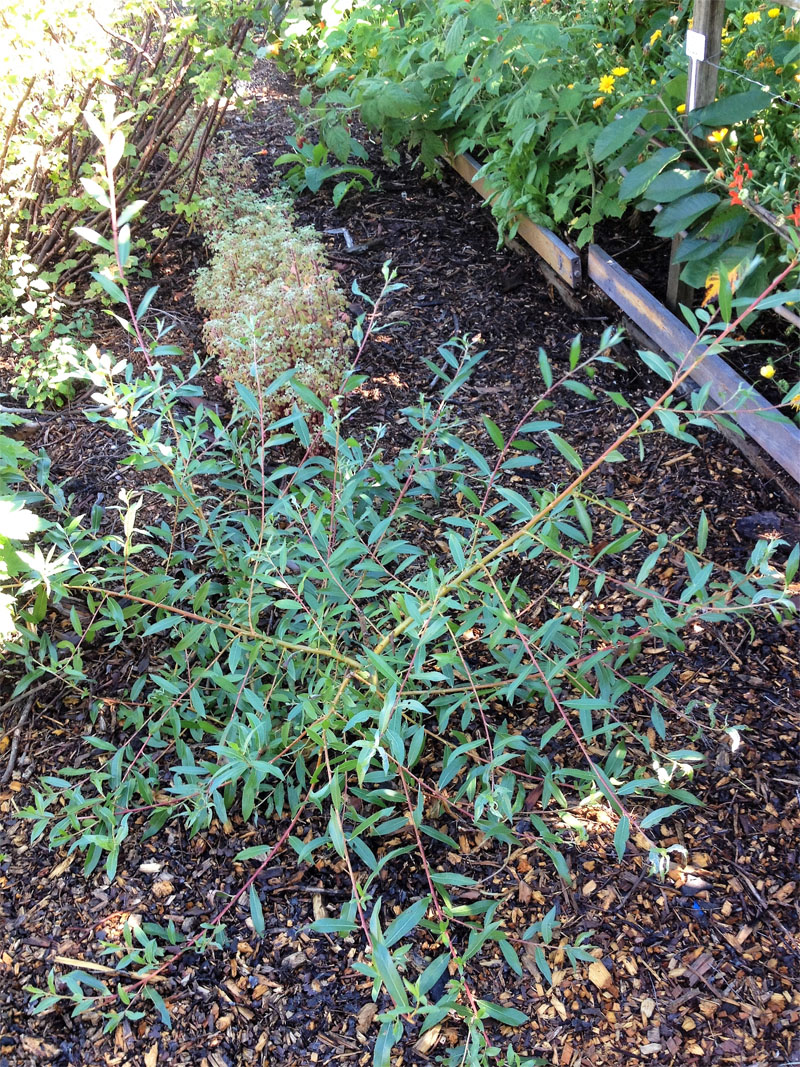
My rooted willow cuttings from stems just pushed into the soil. I put quite a bit of woody
mulch on these too.
I have just been turning the composts today and found some woody stems I threw in  from the willow.  They were right in the middle of the compost and merrily throwing out new growth. 
Layering woody shrubs would not work if this were correct and we would never get Irishmen's cuttings. 
For an explanation to have credibility it must be consistent with all the data collected. Inconsistencies must lead you to question sloppy explanations. 

So here is another piece of data that does not really fit in to the " not too much mulch" hypothesis.  I tend to heap compost, manure and woody chippings around my soft fruit bushes.  They do not die throwing out lots of adventitious roots into the compost.  A little irritating because this means that the roots need to be covered again when the mulch decomposes and they are exposed. 

Blackcurrants and rhubarb with a thick woody shredding mulch.


Blackcurrants with a thick horse manure mulch.


I think that much more tree and shrub death occurs from poor planting practices than the addition of too much mulch. 

Brussel sprouts with a thick woody mulch to stop them from falling over.
Mulching brassicas with compost or hoeing them up does not kill them.  I do this to stop them from flopping over.  The Brussel sprouts produce adventitious roots that root into the mulch or soil. 

Having said all that, I have found that it is unnecessary to add more than a couple of centimeters of woody shreddings to get all the benefits associated with mulching.  Adding more does risk substantial nitrogen drawdown.  This immobilisation of nutrient does have an affect if excessive woody shredding material is used for mulching.

Friday, 30 December 2016

Monday, 26 December 2016

Still learning new things after 50+ years of gardening.

Just read James Wong's article on
https://www.theguardian.com/lifeandstyle/2016/oct/23/coffee-grounds-are-not-good-for-plants-its-a-myth.
So this seems to have come from an auto toxicity of coffee plants and a resultant degradation of the soil for coffee growing in places like Latin America. This has occurred due to tens of years of monoculture. It seems that some of the aromatic herbs like sage will help to ameliorate this problem.
I think that this is a classic example of why monoculture is a bad way of cultivating plants.  Not only do we get depletion of specific nutrients and an increase in pests and diseases but also a build up of potentially growth retarding chemicals. 

It is also an example of the danger of extrapolating scientific results without carefully considering whether this is appropriate. 

In Coffea arabica growing regions of Brazil, coffee fruit peel is composted and used on vegetables, fruit trees and for coffee culture itself not only as an organic fertiliser but also as a weed suppressant.  It seems to slow the growth of fine roots.

There are relatively high concentrations of phenols, flavonoids and caffeine found in extracts.  It is amazing what we find good to drink! One or more of these compounds may have allelopathic properties.  It has been found that coffee bean water extracts and dry powder decrease germination in certain plants.  So needs to be pretty concentrated then?  In other plants there is less germination but stronger seedlings than controls.  This has been interpreted as coffee water extracts and lower dose dry powder have allelopathic effects on some seedlings.  Higher doses of incorporated coffee powder has a depressing allelopathic effect on some  plant's growth. 

I would not really worry about putting coffee grounds on growing beds for at least two reasons. You have just put them through a procedure that removes lots of the chemicals from the bean when it has been percolated. The research papers that I have read use quite concentrated coffee extracts to get an effect.    Secondly, you have not been putting coffee on growing areas for tens of years and finally you are not growing a monoculture of coffee. 

I put my coffee grounds on the compost heap. They are relatively rich in nitrogen even after percolation and this means they will help to accelerate decomposition.

I have used comfrey in the same way as James Wong did coffee grounds in the newspaper article and got similar results. I think that his results could have something to do with too much nitrogen rather than the allelopathic effects of coffee grounds. I would not repeatedly put any chemical on growing areas like this because plants only need tiny amounts of nutrients from the soil.

Are celery plants perennial?  There are lots of vegetable plants that are grown as annuals that are biennials or perennials.  It seems that celery is one of them.  It dies after it has flowered so if you can stop it from flowering, you can keep if for several years.  I find it difficult to stop it flowering in the first year and am delighted when I can pick some for Christmas dinner as I did this year.