I got a bit fed up of sieving the soil today. I am mixing in some new horse manure and the pigeon muck as well as sieving out the stones. The ground has become very wet over the last few days and this means that the soil is a little more reluctant to go through the holes in the bread tray sieve.
It is really time consuming and I am wondering whether to give it up for a while and continue to remove the rest of the stones next autumn.
Sieving is good exercise and produces a very friable soil. The ground is free of cropping vegetables - the beetroot and the carrots are clamped and the parsnips soon will be. So, I might as well sieve the soil now and get it over and done with.
The number of stones that are in this soil is remarkable. It was replacement soil for contaminated soil that was on my allotment and several others. The new soil was supposed to be top quality organic soil. I am not sure whether it was organic because it was clay, full of stone and empty of both nutrients and body. When a soil has no obvious organic matter or small creatures you start to wonder if this soil was treated with chemical fertilisers. These chemicals will kill off things like worms because there is no organic matter in the soil for them to feed on.
This new soil has reacted really well to the addition of copious amounts of compost, manure and cultivation. The soil is finally becoming workable. I am hoping that cultivating the potatoes will help to break it up and work in the organic matter a little more.
I took the top off a 210 litre blue plastic butt to make a water barrel. We have had a lot of rain recently and I am missing collecting it. The down spout was reinstated - it had fallen off in the wind. I am going to duck tape it to the guttering to secure it and then put a small screw through it. The down spout is tied in securely with wire.
There were quite a few slugs in my beer traps a few days ago. I emptied them into the comfrey butt and replaced the beer. I looked today but there were no new slugs in the beer. I am happy about the beer traps being effective.
I put some horse muck on the new sweet pea bed and if I have any left over from the potato bed I will use the left overs on the sweet peas.
Saturday, 31 December 2011

Sunday, 25 December 2011
Raised beds and no dig.
I'm not dead against raised beds or no dig schemes in the allotment. I just think that permanent raised beds need high inputs of water, fertiliser and organic matter. They are also time consuming needing a lot of attention to produce high yields from crowded plants.
Putting large amounts of decomposing organic matter on the surface may deplete the top soil of nitrogen.
Even if you are a strict recycler, all these things will be dependant on oil; if only due to transporting them.
Also, I can't be doing with all the paths. I just look at them and think wasted growing space.
There is some thought that walking on the soil destroys its structure. I cannot for the life of me go along with this. In any case plants will grow through concrete - how compacted is that? Plants still grew even with dinosaurs compacting the ground.
Plants need water which they obtain from the soil through their roots. Roots also obtain dissolved nutrients from the soil and they need energy to do this. To obtain energy they need to respire using oxygen. This means that plants need both water and oxygen in the soil. The more fibrous the structure, the better the relationship between these soil constituents. Walking on soil will squash out some of the air. Walking across wet soil will squash out some of the air and fill the pours with water muddying the soil.
However, needs must and sometimes you just have to work the soil in wet weather. Going over the ground that you have walked on with a fork restores the structure and allows air to enter the ground. However, common sense says trying to work muddied ground when it is pouring down with rain is pointless.
I would suggest that the structure of the soil is much more dependant on its organic and mineral content than whether it is walked on. I read somewhere that if you get the calcium and magnesium content of the soil just right you can park you car on the soil and still have a friable soil. I would like to try this out before I recommend it though - and that will never happen.
So I will continue to use larger areas, wider spacing, less watering and sharp tools to cultivate the soil and produce good harvests.
Having said all this my beds, which are about 15 foot by 25 foot, are all raised above the original ground level. One of the old blokes on the allotment site said why didn't I use old paving slabs on end to keep the soil from falling on the paths and track ways. This was a good idea and I have, over the years, put paving slabs around most of the beds.


The ground was raised by the addition of lots of organic matter. It didn't really matter to me what the organic matter was, it still got buried. I have buried old cotton shirts, leather handbags and shoes; leather belts; woollen jumpers and socks; tree and shrub shreddings; shredded paper; weeds except for bind weed and mares tail; tree trunks and branches; lots of tree leaves, muck and manures. I used to bury woollen carpets too until I found they put nasty chemicals on them to prevent them being eaten by moths and fungi.

All these additions to the soil were buried at least two spits down and mostly further than this. When I dig down now I find nothing except a darker stained subsoil. The nutrients and carbon locked up in the structure of organic material is slowly returned to the soil to increase its fertility.
Apart from vastly improving the drainage of the allotment and enabling me to use the ground year round, the raised bed is like a hot bed. The decomposing organic matter generates a certain amount of heat and this can warm the soil enabling seeds to germinate earlier - or that is the theory anyway.
To make the raised hot bed, I don't pile organic matter on the top of the soil. I bury it deep in the soil. I do this because I do not want it to deplete the top soil nitrogen. Putting organic matter on the surface of the soil may deplete the soil of nitrogen when it decomposes. I know there are many benefits of mulching but it needs to be done with understanding and more care than is often suggested. Piling on mulches is not a magic solution to all your gardening problems. It is just one more strategy in the armoury of methods you can use on the allotment.
So my beds are raised but they are much bigger than any other raised beds that I have seen.
There is nothing wrong with raised small beds done well but I can't be doing with them. They are too small for my way of gardening.
And this time of year I just like to go out and dig for an hour or so. Allotments are not just for growing; they are for fresh air and exercise too.
Putting large amounts of decomposing organic matter on the surface may deplete the top soil of nitrogen.
Even if you are a strict recycler, all these things will be dependant on oil; if only due to transporting them.
Also, I can't be doing with all the paths. I just look at them and think wasted growing space.
There is some thought that walking on the soil destroys its structure. I cannot for the life of me go along with this. In any case plants will grow through concrete - how compacted is that? Plants still grew even with dinosaurs compacting the ground.
Plants need water which they obtain from the soil through their roots. Roots also obtain dissolved nutrients from the soil and they need energy to do this. To obtain energy they need to respire using oxygen. This means that plants need both water and oxygen in the soil. The more fibrous the structure, the better the relationship between these soil constituents. Walking on soil will squash out some of the air. Walking across wet soil will squash out some of the air and fill the pours with water muddying the soil.
However, needs must and sometimes you just have to work the soil in wet weather. Going over the ground that you have walked on with a fork restores the structure and allows air to enter the ground. However, common sense says trying to work muddied ground when it is pouring down with rain is pointless.
I would suggest that the structure of the soil is much more dependant on its organic and mineral content than whether it is walked on. I read somewhere that if you get the calcium and magnesium content of the soil just right you can park you car on the soil and still have a friable soil. I would like to try this out before I recommend it though - and that will never happen.
So I will continue to use larger areas, wider spacing, less watering and sharp tools to cultivate the soil and produce good harvests.
Having said all this my beds, which are about 15 foot by 25 foot, are all raised above the original ground level. One of the old blokes on the allotment site said why didn't I use old paving slabs on end to keep the soil from falling on the paths and track ways. This was a good idea and I have, over the years, put paving slabs around most of the beds.


The ground was raised by the addition of lots of organic matter. It didn't really matter to me what the organic matter was, it still got buried. I have buried old cotton shirts, leather handbags and shoes; leather belts; woollen jumpers and socks; tree and shrub shreddings; shredded paper; weeds except for bind weed and mares tail; tree trunks and branches; lots of tree leaves, muck and manures. I used to bury woollen carpets too until I found they put nasty chemicals on them to prevent them being eaten by moths and fungi.

All these additions to the soil were buried at least two spits down and mostly further than this. When I dig down now I find nothing except a darker stained subsoil. The nutrients and carbon locked up in the structure of organic material is slowly returned to the soil to increase its fertility.
Apart from vastly improving the drainage of the allotment and enabling me to use the ground year round, the raised bed is like a hot bed. The decomposing organic matter generates a certain amount of heat and this can warm the soil enabling seeds to germinate earlier - or that is the theory anyway.
To make the raised hot bed, I don't pile organic matter on the top of the soil. I bury it deep in the soil. I do this because I do not want it to deplete the top soil nitrogen. Putting organic matter on the surface of the soil may deplete the soil of nitrogen when it decomposes. I know there are many benefits of mulching but it needs to be done with understanding and more care than is often suggested. Piling on mulches is not a magic solution to all your gardening problems. It is just one more strategy in the armoury of methods you can use on the allotment.
So my beds are raised but they are much bigger than any other raised beds that I have seen.
There is nothing wrong with raised small beds done well but I can't be doing with them. They are too small for my way of gardening.
And this time of year I just like to go out and dig for an hour or so. Allotments are not just for growing; they are for fresh air and exercise too.
Thursday, 22 December 2011
Heritage or modern seed?
I have bought quite a few seeds from the Real Seeds Catalogue but maybe I should have tried a little harder to buy heritage seeds.
http://www.realseeds.co.uk/
However, if you want disease resistant varieties because you need to grow without pesticides then sometimes you need to compromise. Also, I want to be able to keep some of my vegetables stored over winter and these good keeping varieties are not necessarily heritage. Cauliflower: Brassica oleracea botrytis 'Clapton F1 Hybrid' is a club root resistant variety so I thought that I would try it. It was also half price in an end of season sale so I could not resist it. (Several others of the F1 seeds were in the sale as well so I got them too) I have been growing Daucus carota 'Flyaway F1 Hybrid' for years to combat carrot root fly. This year I am growing Resistafly F1 Hybrid.
The bottom line is to produce some organic carrots to eat. To make this a little more certain I will be growing crops that are resistant to pests.
I would like to believe that heritage plants have a greater affinity for mychorrhizal fungi and grow even better with charcoal but I have not found any significant difference between modern varieties and heritage grown with charcoal. Both types of plants seem to benefit from the application of inoculated charcoal and mychorrhiza. Keeping the old varieties going is more to do with biodiversity than anything else.
I have two dust bins full of marinading lump wood, barbecue charcoal. The liquid is made up of comfrey, nettle, sweet cicely, worm bin and diluted pigeon manure. It has been marinading for at least five months now and I will not use it until the spring. I reckon that will be ample time for the charcoal to take up nutrients.
It will be used on the potatoes first. I cannot get barbecue charcoal at the moment because there is none in the shops, however I still have the Takesumi charcoal to experiment with.
While some of the old vegetable varieties are better flavoured there are many that are not and they are not so disease resistant either.
Looking around the allotment site people are using the same varieties year after year because they grow well in our allotment soil with our north facing aspect. These varieties are more or less the same as I am growing some of which are F1 hybrids. I think that I will continue to buy F1 seed at the moment.
Finally, I have got into growing particular varieties and want to carry on if I can.
This is why I kept some seed in 2011 and I am going to sow it during next season (2012). Seed saving has been quite successful this year so I am going to continue to collect my own seed. For this I need non F1 hybrids because only these will breed true. Maybe this is an argument for selecting heritage seeds. So, there are good reasons for getting both F1 hybrids and heritage seed and I will be using both.
http://www.realseeds.co.uk/
However, if you want disease resistant varieties because you need to grow without pesticides then sometimes you need to compromise. Also, I want to be able to keep some of my vegetables stored over winter and these good keeping varieties are not necessarily heritage. Cauliflower: Brassica oleracea botrytis 'Clapton F1 Hybrid' is a club root resistant variety so I thought that I would try it. It was also half price in an end of season sale so I could not resist it. (Several others of the F1 seeds were in the sale as well so I got them too) I have been growing Daucus carota 'Flyaway F1 Hybrid' for years to combat carrot root fly. This year I am growing Resistafly F1 Hybrid.
The bottom line is to produce some organic carrots to eat. To make this a little more certain I will be growing crops that are resistant to pests.
I would like to believe that heritage plants have a greater affinity for mychorrhizal fungi and grow even better with charcoal but I have not found any significant difference between modern varieties and heritage grown with charcoal. Both types of plants seem to benefit from the application of inoculated charcoal and mychorrhiza. Keeping the old varieties going is more to do with biodiversity than anything else.
I have two dust bins full of marinading lump wood, barbecue charcoal. The liquid is made up of comfrey, nettle, sweet cicely, worm bin and diluted pigeon manure. It has been marinading for at least five months now and I will not use it until the spring. I reckon that will be ample time for the charcoal to take up nutrients.
It will be used on the potatoes first. I cannot get barbecue charcoal at the moment because there is none in the shops, however I still have the Takesumi charcoal to experiment with.
While some of the old vegetable varieties are better flavoured there are many that are not and they are not so disease resistant either.
Looking around the allotment site people are using the same varieties year after year because they grow well in our allotment soil with our north facing aspect. These varieties are more or less the same as I am growing some of which are F1 hybrids. I think that I will continue to buy F1 seed at the moment.
Finally, I have got into growing particular varieties and want to carry on if I can.
This is why I kept some seed in 2011 and I am going to sow it during next season (2012). Seed saving has been quite successful this year so I am going to continue to collect my own seed. For this I need non F1 hybrids because only these will breed true. Maybe this is an argument for selecting heritage seeds. So, there are good reasons for getting both F1 hybrids and heritage seed and I will be using both.
Monday, 19 December 2011
Seeds for 2012
These are the seeds that I am going to use in the new year. Sometimes I like to grow specific varieties so I have bought the seeds from various companies. Not all the seeds have a cultivar or variety. There are 64 different kinds of vegetable, herb and soft fruit here. Some are already in the ground while I am getting very impatient about planting some of the others.
The allotment plan does not allow for all of these seeds and I will probably be keeping some of them for next year or for later planting.
Vegetables that I have never grown before are Tarragon, Salad Burnet, Dill, Cumin, Asparagus Pea and Parcel. Now I think that parcel is a bit of a con because it is celeriac under a different name. It says that you eat the petioles and leaves rather than the swollen stem. Oh well, I'll give it a try.
Getting these latin names right is a pain. Brussel sprouts in Johnson and Smith's "Plant names simplified" are called Brassica oleracea bullata, while elsewhere they are referred to as Brassica oleracea var. gemmifera. Now, I would go with bullata because that means bubbles or blisters and is a good description of the buds. However gemmifera means a similar thing - a plant with stem buds. The RHS who seem to be the authority on these kinds of names calls Brussel sprouts Brassica oleracea gemmifera so that is what I will do. I have had the same difficulty with the swede. It is a type of Brassica napus that colours the fields with yellow in the summer.
I haven't grown celery for a very long time. It is very demanding of both nutrients and water. I am going to grow it at the bottom of a trench to see if I can keep it damp enough. It is also very susceptible to slug damage so I am trying to reduce the slug and snail population now. This means that there will not be so many next year to reproduce and create a problem. At the moment I am using beer traps and Ferric phosphate but next year I plan to use a lot more nematodes Phasmarhabditis hermaphorodita to help to keep the slug and snail population down.
I think that I will have a lovely variety of vegetables next year. Now all I want is to find some really great recipes for cooking them.
| Vegetable | Latin Name | Cultivar |
| American land cress | Barbarea verna | |
| Asparagus Pea | Tetragonolobus purpureus | ¬¬¬¬¬¬¬¬¬¬ |
| Basil | Ocimum basilicum | Dark Opal |
| Bay tree | Laurus nobilis | |
| Beetroot | Beta vulgaris | Boltardy |
| Beetroot | Beta vulgaris | Wodan F1 Hybrid |
| Birds foot trefoil | Lotus corniculatus | ¬¬¬¬¬¬¬¬¬¬¬ Just a companion plant |
| Black berry | Rubus fruticosus | Adrienne |
| Black currant | Ribes nigrum | Ben Sarek |
| Black currant | Ribes nigrum | Ben Lomond |
| Borlotti beans | Phaseolus vulgaris | Cuthbert's |
| Broad bean | Vicia faba | Own kept seeds |
| Broccoli | Brassica oleracea | Early Purple blend |
| Broccoli | Brassica oleracea | Sprouting Redhead |
| Brussel sprouts | Brassica oleracea var. gemmifera | Trafalgar |
| Cabbage | Brassica oleracea capitata | Holand Winter White |
| Cabbage | Brassica oleracea capitata | Sherwood |
| Cabbage | Brassica oleracea capitata | Golden Acre Primo (II) |
| Calabrese | Brassica oleracea | Belstar F1 hybrid |
| Calabrese | Brassica oleracea | Green Sprouting |
| Carrot | Daucus carota | Early Nants |
| Carrot | Daucus carota | Resistafly |
| Carrot | Daucus carota | Nandor F1 Hybrid |
| Cauliflower | Brassica oleracea botrytis | Clapton F1 Hybrid |
| Cauliflower | Brassica oleracea botrytis | Winter Alsmeer |
| Cauliflower | Brassica oleracea botrytis | All the year round |
| Celeriac | Apium graveolens rapaceum | Monarch |
| Celery | Apium graveolens var dulce | Lanthorn Self Blanching |
| Celery | Apium graveolens var dulce | Full White (Self Blanching) |
| Celery | Apium graveolens var dulce | Granada |
| Chamomile | Anthemis nobilis | ¬¬¬¬¬¬¬¬ |
| Chicory | Cichorium intybus | ¬¬¬¬¬¬¬¬¬¬¬ |
| Courgette | Cucurbita pepo ovifera | Black Beauty |
| Cucumber | Cucumis sativus | Wautoma |
| Cumin | Cuminum cyminum | ¬¬¬¬¬¬¬¬¬¬ |
| Dill | Anethum gaveolens | ¬¬¬¬¬¬¬¬¬¬ |
| Florence fennel | Foeniculum vulgare | Colossal |
| French beans | Phaseolus vulgaris | Own kept seeds |
| French climbing bean | Phaseolus vulgaris | Cherokee Trail of Tears |
| French climbing bean | Phaseolus vulgaris | Own kept seeds 'Cobra' |
| Garlic | Allium sativum | |
| Goosberry bush | Ribes grossularia | Xenia |
| Grape | Vitis vinifera | |
| Hamburg parsley | Petroselinum crispum | Berliner |
| Jerusalem Artichoke | Heleanthus tuberosus | |
| Kohlrabi | Brassica oleracea caulo-rapa | Gigant |
| Lambs lettuce | Valerianalla locusta | Cavallo |
| Leek | Allium porrium | Oarsman F1 Hybrid |
| Leek | Allium porrum | Mammoth Blanched |
| Leeks | Allium porrum | Bleu de Solaise |
| Leek | Allium porrum | Musselburgh |
| Lettuce | Lactuca sativa | Webbs Wonderful |
| Marjoram | Origanum majorana | ¬¬¬¬¬¬¬¬¬¬¬ |
| Mizuna | Brassica rapa | Waido |
| Oca | Oxalis tuberosum | ¬¬¬¬¬¬¬¬ |
| Onion | Allium cepa | Vision |
| Onion | Allium cepa | Ailsa Craig |
| Allium cepa | Mammoth Improved | |
| Onion | Allium cepa | Bedfordshire Champion |
| Parcel | Apium graveolens var secalinum | ¬¬¬¬¬¬¬¬¬¬¬ |
| Parsnip | Pastinaca sativa | Tender and True |
| Pea | Pisum sativum | Early Onward |
| Pea | Pisum sativum | Hurst Green Shaft |
| Pea | Pisum sativum | Onward |
| Potato | Solanum tuberosum | Kestrel |
| Pumpkin | Cucurbita pepo | Rouge Vif dEtamps |
| Radish | Raphanus sativus | Cherrybelle |
| Raspberry | Rubus idaeus | |
| Rhubarb | Rheum rhaponticum | Champaign |
| Rhubarb | Rheum rhaponticum | Timperley Early |
| Rocket | Eruca sativa | Sweet Oakleaf |
| Runner bean | Phaseolus coccinus | Own kept seeds |
| Sage | Salvia officinalis | Green Leaved |
| Salad Burnet | Sanguisorba minor | ¬¬¬¬¬¬¬¬¬¬¬¬¬ |
| Salsify | Tragopogon porrifolius | ¬¬¬¬¬¬¬¬¬¬¬¬¬ |
| Scorzonera | Scorzonera hispanica | Maxima |
| Shallots | Allium ascalonicum | Jermore |
| Spinach | Spinacia oleracea | Mediana |
| Spinach | Spinacia oleracea | Renegade F1 Hybrid |
| Squash | Cucurbita moschata | Waltham butternut |
| Strawberries | Fragaria ananassa | Cambridge |
| Swede | Brassica napus napobrassica | Gowrie |
| Sweet cicely | Osmorhiza claytonii | ¬¬¬¬¬¬¬¬¬¬¬¬ |
| Sweet corn | Zea mays | Double Standard |
| Sweet corn | Zea mays | Northern Extra Sweet |
| Sweet pea | Lathyrus odoratus | Many |
| Swiss Chard | Beta vulgaris subsp. Cicla | Galaxy |
| Tarragon | Artemisia dracunculoides | ¬¬¬¬¬¬¬¬¬¬¬¬¬¬ |
| Tomato | Lycopersicon esculentum. | Rose de Berne |
| Tomato | Lycopersicon esculentum. | Dr Carolyn Pink |
| Tomato | Lycopersicon esculentum. | Latah (Bush) |
| Turnip | Brassica rapa | Oasis |
| Turnip | Brassica rapa | Galaxy F1 |
The allotment plan does not allow for all of these seeds and I will probably be keeping some of them for next year or for later planting.
Vegetables that I have never grown before are Tarragon, Salad Burnet, Dill, Cumin, Asparagus Pea and Parcel. Now I think that parcel is a bit of a con because it is celeriac under a different name. It says that you eat the petioles and leaves rather than the swollen stem. Oh well, I'll give it a try.
Getting these latin names right is a pain. Brussel sprouts in Johnson and Smith's "Plant names simplified" are called Brassica oleracea bullata, while elsewhere they are referred to as Brassica oleracea var. gemmifera. Now, I would go with bullata because that means bubbles or blisters and is a good description of the buds. However gemmifera means a similar thing - a plant with stem buds. The RHS who seem to be the authority on these kinds of names calls Brussel sprouts Brassica oleracea gemmifera so that is what I will do. I have had the same difficulty with the swede. It is a type of Brassica napus that colours the fields with yellow in the summer.
I haven't grown celery for a very long time. It is very demanding of both nutrients and water. I am going to grow it at the bottom of a trench to see if I can keep it damp enough. It is also very susceptible to slug damage so I am trying to reduce the slug and snail population now. This means that there will not be so many next year to reproduce and create a problem. At the moment I am using beer traps and Ferric phosphate but next year I plan to use a lot more nematodes Phasmarhabditis hermaphorodita to help to keep the slug and snail population down.
I think that I will have a lovely variety of vegetables next year. Now all I want is to find some really great recipes for cooking them.
Sunday, 18 December 2011
Keeping sweet pea seeds
This year I have kept a lot of sweet pea seeds and planted them in pots at the end of October. They have all germinated well. My assumption was that they would not breed true because of cross pollination between varieties that were grown quite close to each other.
However, it seems that sweet peas are normally self pollinated. While this may suggest that all sweet pea seeds will breed true, there is some doubt whether this is always the case. My sweet pea plants were not protected from cross pollination - they were "open pollinated".
Now I had always thought that a bumble bee landing on the keel petals of the flower would make the stamen pop out and coat the underside of the bee with pollen which would then be taken to the next flower. The fact that the stamen and stigma are protected by the keel petals seems to give the flower more chance of self pollination. When the flower has gone over, pollen has been shed and fallen on the stigma which does not normally protrude from the petals giving a self pollinated flower.
If the sweet pea is self pollinated then it should be quite easy to keep varieties pure because they would only change by mutation. This might give the opportunity for saving seed with some reliability that doing so would produce the same variety as the parents.
However, it seems that sweet peas are normally self pollinated. While this may suggest that all sweet pea seeds will breed true, there is some doubt whether this is always the case. My sweet pea plants were not protected from cross pollination - they were "open pollinated".
Now I had always thought that a bumble bee landing on the keel petals of the flower would make the stamen pop out and coat the underside of the bee with pollen which would then be taken to the next flower. The fact that the stamen and stigma are protected by the keel petals seems to give the flower more chance of self pollination. When the flower has gone over, pollen has been shed and fallen on the stigma which does not normally protrude from the petals giving a self pollinated flower.
If the sweet pea is self pollinated then it should be quite easy to keep varieties pure because they would only change by mutation. This might give the opportunity for saving seed with some reliability that doing so would produce the same variety as the parents.
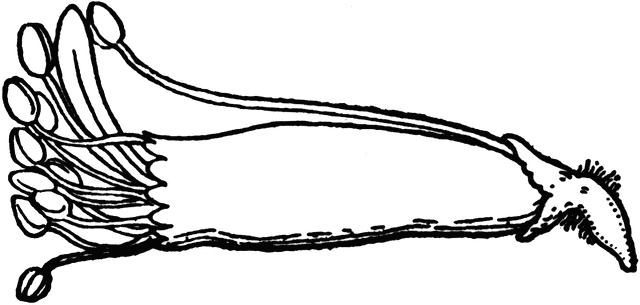 |
| Stamens and stigma of sweet pea Lathyrus odoratus (FCIT) |
I'm not so sure and will carefully examine flowers next year to see if this is true. Unfortunately, I mixed up all the seeds that I gathered this year so I will get a mixture of colours when I plant them out next year.
Subscribe to:
Posts (Atom)